
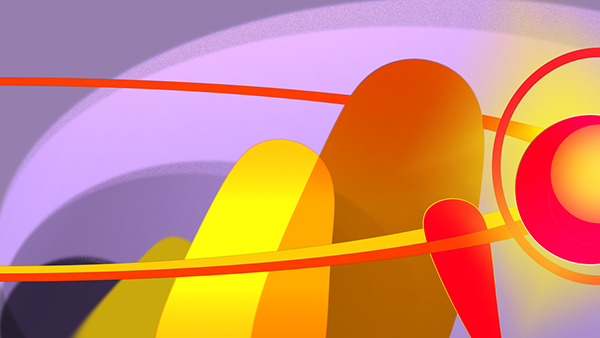

Back in March 2013, I was tasked with conceiving of a way in which an entire community of animation students, staff and alumni could work together on a big external EU-funded project, the goal of which was to visualise classical music engagingly and thus initiate new audiences into the concert-going experience:
“On Friday, July 12th at Grays Civic Hall, Essex, the Orchestre Symphonique de Bretagne will be performing a programme of music on a theme of ‘rhythm’. The programme of music will explore ideas of rhythm in classical music and in the celebrated jazz of the late Dave Bruebeck. The director of the Orchestre Symphonique de Bretagne, Marc Feldman, has challenged our creative community to work collaboratively to create an original work of animation designed to accompany his orchestra’s performance of one particular example of early twentieth century music that blends classical and jazz rhythms to exciting effect. The animation will be rear projected onto a large screen measuring 8.5m wide by 6.2m high, in front of which the Orchestre Symphonique de Bretagne will perform live.“
That ‘particular example of early twentieth century music’ was Darius Milhaud’s 1923 ballet, La Création du monde. I was entirely unfamiliar with the piece, but on hearing it for the first time, I was struck by its many contrasting textures, moving from lyricism to rattling percussion, and back again. My mind offered up abstract shapes, ribbons of colour, starbursts, wheeling cogs and the metropolitan rush of beeping cars and honking trains, and all the clamour and noise of modernity. What a gift to animators, I thought, and so it proved to be.
Over the course of ten consecutive days, the course community were challenged to listen to Milhaud’s ballet and ‘draw what they could hear’, producing abstract digital paintings as quickly and instinctively as possible in an effort to ‘photograph’ the synesthetic imagery inspired by the music. Of the many exciting projects my students and I undertook together, this stint of extra-curricular activity was particularly joyous, as everyone just rolled up their sleeves and painted. In the end, a huge range of speed paintings were generated in response to Milhaud’s music, the entire collection of which can be viewed here.
I’ve gathered by own efforts here, blowing off the dust. Produced very quickly, produced blithely, they still manage to cheer me up. When I look at these images, I recall the fireworks of Milhaud’s music instantly and likewise the very real pleasure of working side-by-side with such a lovely bunch of bright young things.


 Red's Kingdom
Leave a comment