

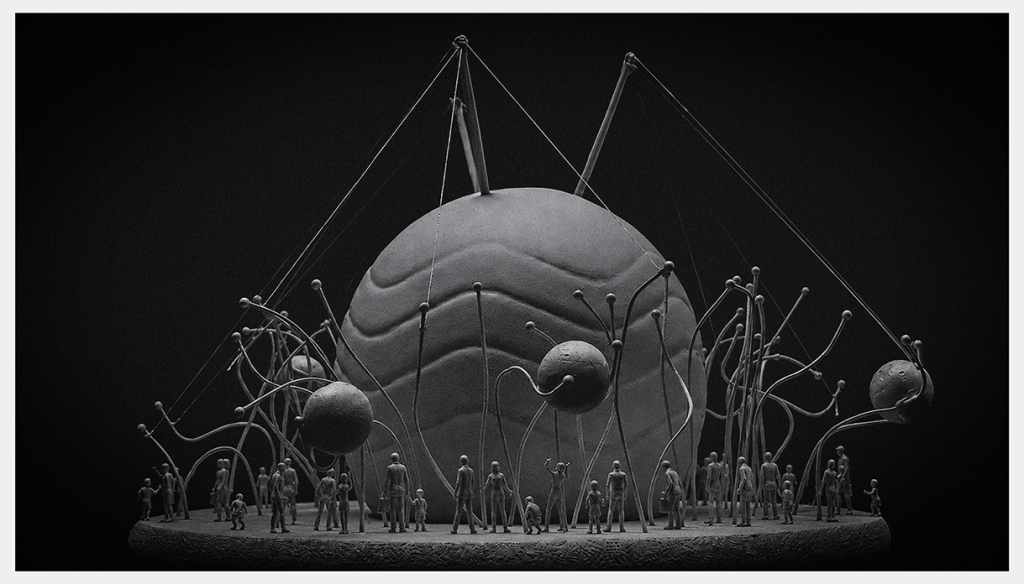
My immediate association with Lee Bontecou’s sculptures and drawings was the kind of speculative, temporary architecture you see at world expos, like the 1951 Festival of Britain. I was thinking about masts, tensile structures and suspended orbs – pavilions showcasing ‘the modern’. With this in mind, I set about kit-bashing an architectural maquette for our latest Bontecou-inspired Kick-About: a globe cast in plaster from a mould derived from the top of a 2 litre water bottle; cork balls, bendy jeweller’s pins, a cork placemat and some silver thread.


With the maquette made (but with no thought given to the scale), I wanted to include some people, but the ones I have were too big. I wondered if this was a reasonable use-case for generative AI, so I uploaded one of my photographs and prompted for the inclusion of some architectural modeller’s figures. I asked that the figures should look like the mass-produced ones, so as wobbly in places. The results of that prompt are below. The maquette itself is unchanged.

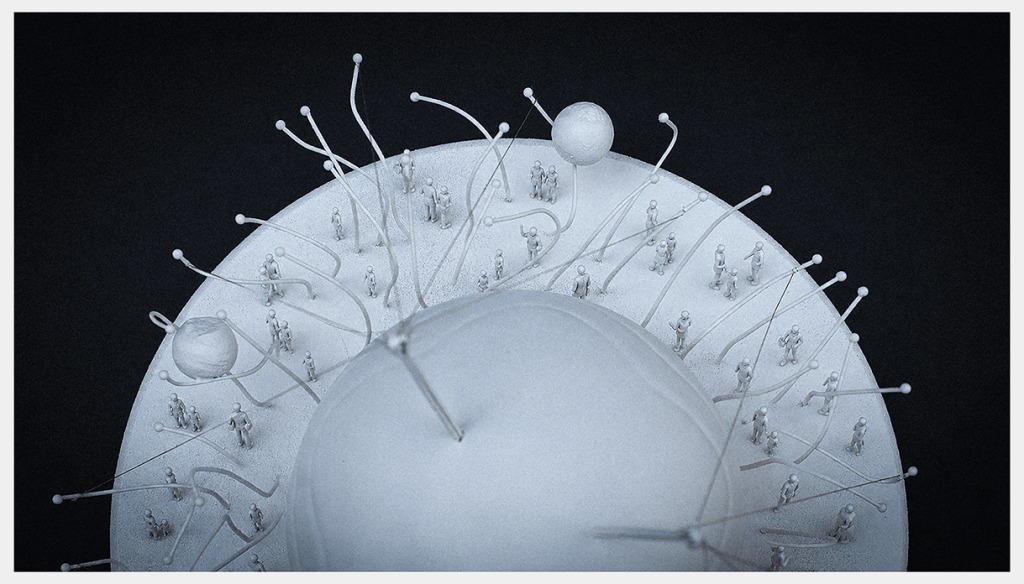


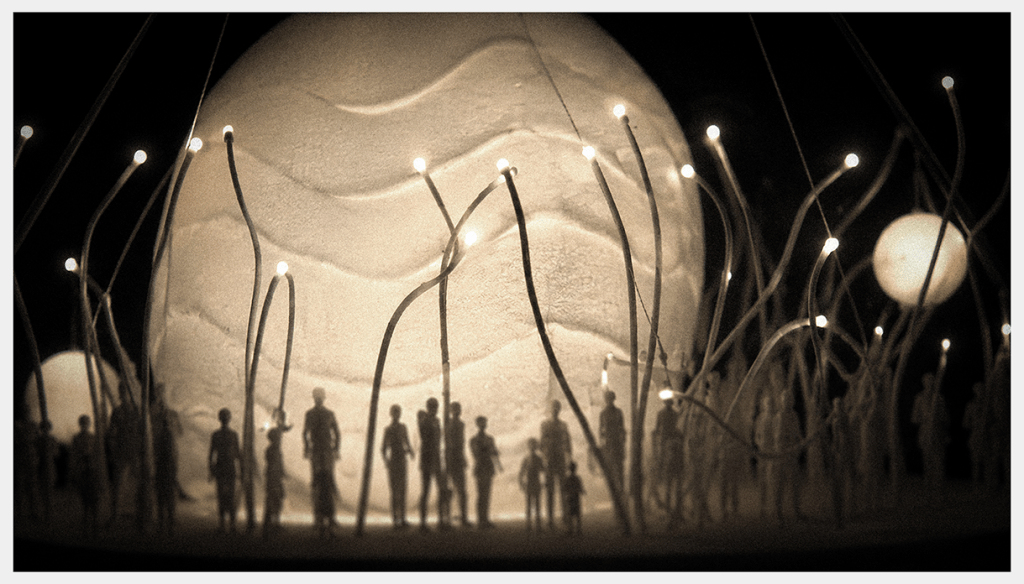
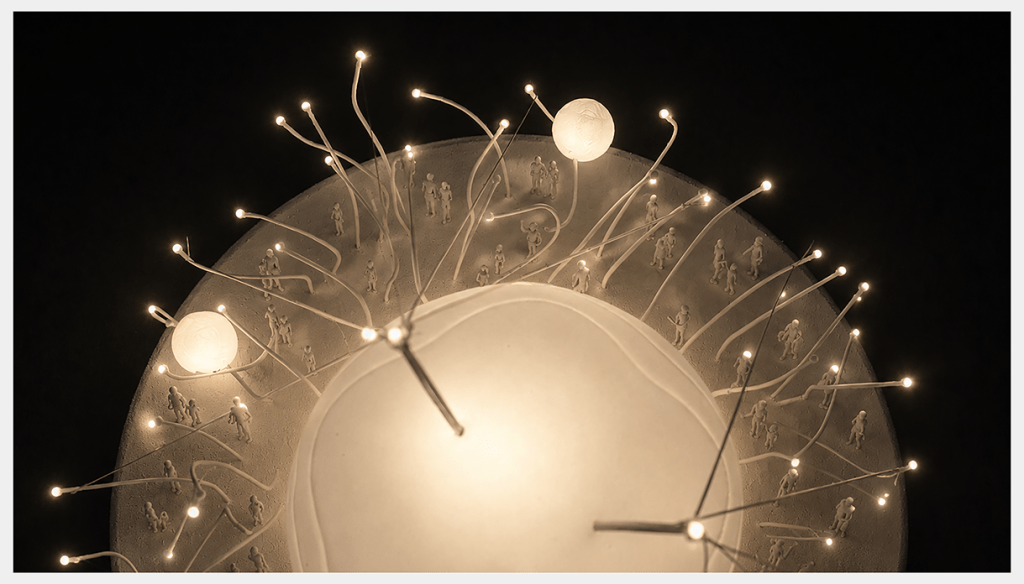
I’d always imagined my ‘Bontecou Pavilion’ to be an illuminated structure; it has this celestial feeling, so I experimented again to see if I could prompt for my architectural model to be illuminated as an architectural model would be illuminated, so with LEDs etc (the stem-like structures topped with lights, and the orbs lit from within like moons). Hand-on-heart, the ability to art direct these maquette photos ‘post-shoot’ was exciting.




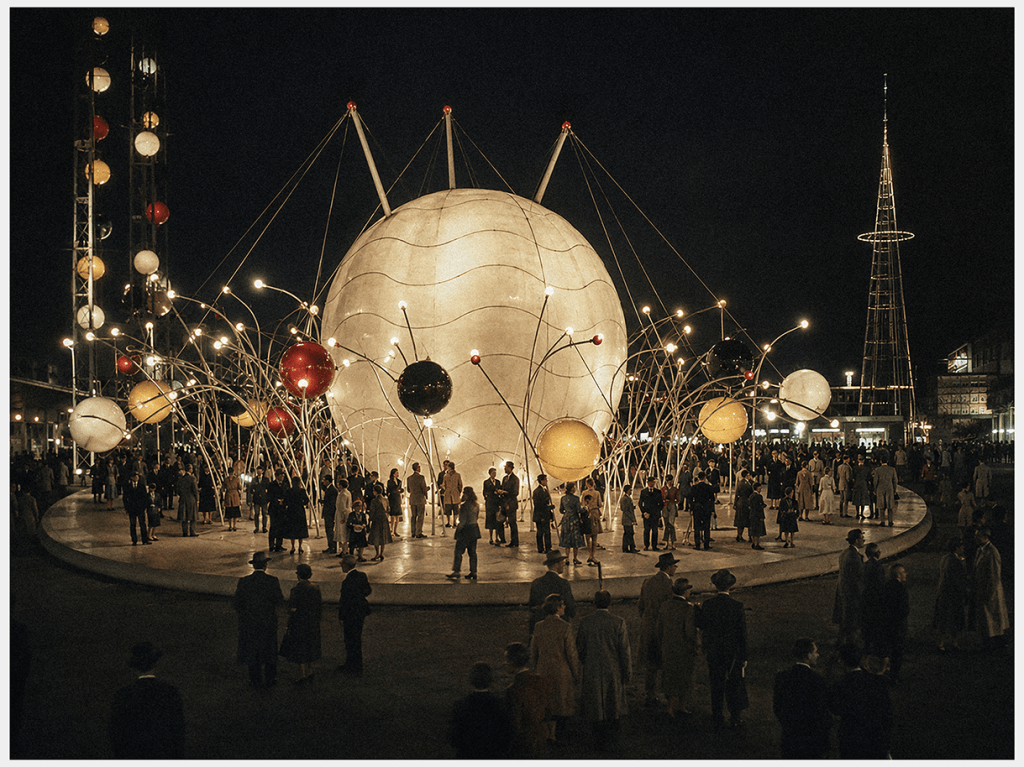
Finally, given my original inspiration for the creation of the architectural maquette, I was curious to see if I could complete the logic of this Kick-About, by situating my Bontecou Pavilion in the environs of the Festival of Britain itself. The images below are AI generated obviously, after working with the tool to establish the materiality of the pavilion as a ‘real installation’ in a ‘real’ time frame. The ability to move from a hands-on maquette built from found objects to this ‘never-never land’ was pretty satisfying. This is the first time I’ve used AI in this additive way and while I appreciate there is ambivalence about its use (and abuse), this direct editing-into-my-photographs workflow reminded me of the early days of digital re-touching in Photoshop – which also felt as just as helpful and just as ‘is this okay?’.



 Red's Kingdom
Leave a comment